

Closing the Gaps: Vendor Risk, Sector Realities, and the Case for AI Governance
Part 2 and 3 of the AI Governance Thought Leadership Series
By Norwin Estrada - Risk Management Practice Leader
The Real Cost of Waiting: Vendor AI Risk and the Business Case for Governance
Here's a scenario that plays out constantly across financial services right now. A firm contracts with a vendor to provide a platform, fraud detection, loan origination, AML monitoring, portfolio analytics, deal sourcing. Embedded in that platform is a machine learning model making real decisions. The firm's risk team reviews the contract. They check the SOC 2. They run the standard TPRM questionnaire.
Nobody asks how the model was trained. Nobody asks what data went into it. Nobody asks what happens when the vendor pushes an update. Nobody asks who's accountable when it gets it wrong.
And then it gets it wrong, and the regulatory finding, the client complaint, or the deal-level liability lands on the firm, not the vendor.
This isn't a hypothetical. It's the pattern that regulators, plaintiffs' attorneys, and AI liability insurers are watching closely right now, across banking, asset management, and private equity alike.
The Vendor AI Blind Spot
Third-party vendors are the dominant AI delivery channel across financial services. Most institutions and firms have never formally inventoried these tools as models, let alone validated or monitored them.
The use cases vary by sector, but the governance gap is the same. Banks and mortgage lenders rely on vendor AI for underwriting decisions, fraud alerts, and AML triage, tools that directly influence regulatory outcomes and fair lending exposure. Asset managers use vendor AI for portfolio risk analytics, trade execution optimization, and client reporting, systems that affect fiduciary obligations and performance attribution. Private equity firms are increasingly using AI-powered platforms for deal sourcing, target screening, and portfolio company benchmarking, tools that shape investment theses and, increasingly, LP expectations around due diligence rigor.
SR 26-2 is clear on accountability: outsourcing a model does not transfer the regulatory responsibility. What it transfers is visibility, which is exactly the problem. Most firms have no line of sight into how their vendor AI was built, what data it was trained on, or whether it's been tested for the specific exposures relevant to their business.
What Standard TPRM Misses
Most third-party risk management programs were built for a pre-AI world. They assess operational resilience. They review data security posture. They check business continuity plans. All important, and none of it addresses the model governance practices inside a vendor's AI product.
They don't ask whether a vendor's credit model has been tested for disparate impact. They don't ask whether a portfolio analytics model has been validated on data that matches the firm's actual investment universe. They don't ask whether a deal-sourcing AI has been stress-tested for market regime changes or whether its outputs carry any audit trail. They don't ask who to call when the model starts behaving differently after a silent update.
Those aren't exotic questions. They're what separate firms with defensible AI risk postures from those that have effectively outsourced their risk management to a vendor capping liability at 12 months of fees.
The vendor agreement protects the vendor. Your governance program is what protects your firm.
The Upside Nobody Talks About
Here's what gets overlooked: getting serious about vendor AI risk gives your firm leverage it wouldn't otherwise have.
Firms with mature vendor AI due diligence can negotiate better contracts, extract more transparency from vendors competing for their business, and move faster on vendor AI deployments because the evaluation process already exists. In banking, that means new fraud or lending AI tools can go live in weeks rather than months. In asset management, it means AI-powered analytics platforms can be onboarded with confidence rather than anxiety. In private equity, it means due diligence on acquisition targets that use AI can be completed, and documented, in a way that holds up to LP scrutiny.
Vendor AI risk management isn't just defensive. Done well, it's a competitive advantage, the difference between firms that can move on AI opportunities quickly and firms that are perpetually stuck in a review process with no defined endpoint.
What Is AI Governance Actually Worth?
At some point in every AI governance conversation, someone with a budget asks a version of the same question: what's the return on this investment? It's a fair question. Governance programs have historically been hard to quantify, which is a big part of why they've historically been underfunded.
AI governance, done right, is actually one of the more measurable investments a financial services firm can make. The costs of not doing it are specific, observable, and increasingly well-documented. The ROI case has three components: risk avoidance, operational efficiency, and revenue enablement. Most firms only make the first argument. The full picture is considerably more compelling.
Dimension 1: Risk Avoidance Value
The downside of ungoverned AI is quantifiable in ways that traditional operational risk events often aren't. The numbers already on the books are instructive. Generative AI-related lawsuits in the U.S. grew significantly between 2021 and 2025. AI examination findings at regulated institutions are generating remediation costs ranging from hundreds of thousands to several million dollars. Cyber insurance exclusions for AI-related incidents are expanding. The risk of uninsured loss from an AI incident is rising, not falling.
But the risk avoidance calculus looks different depending on sector. For banks and mortgage lenders, the primary exposure is fair lending liability and examination findings tied to AI-assisted underwriting. A single consent order tied to an ungoverned AI model can carry direct costs well into eight figures, plus the operational drag of years of enhanced supervision. For asset managers, the exposure is fiduciary liability and client trust, the cost of an AI-driven investment decision that can't be explained to a client or a regulator. For private equity, it's increasingly deal-level: firms that can't demonstrate AI governance standards during due diligence are starting to see it reflected in valuations and investor expectations.
Dimension 2: Operational Efficiency Gains
This is the component most governance conversations skip, and it's often the largest number on the table.
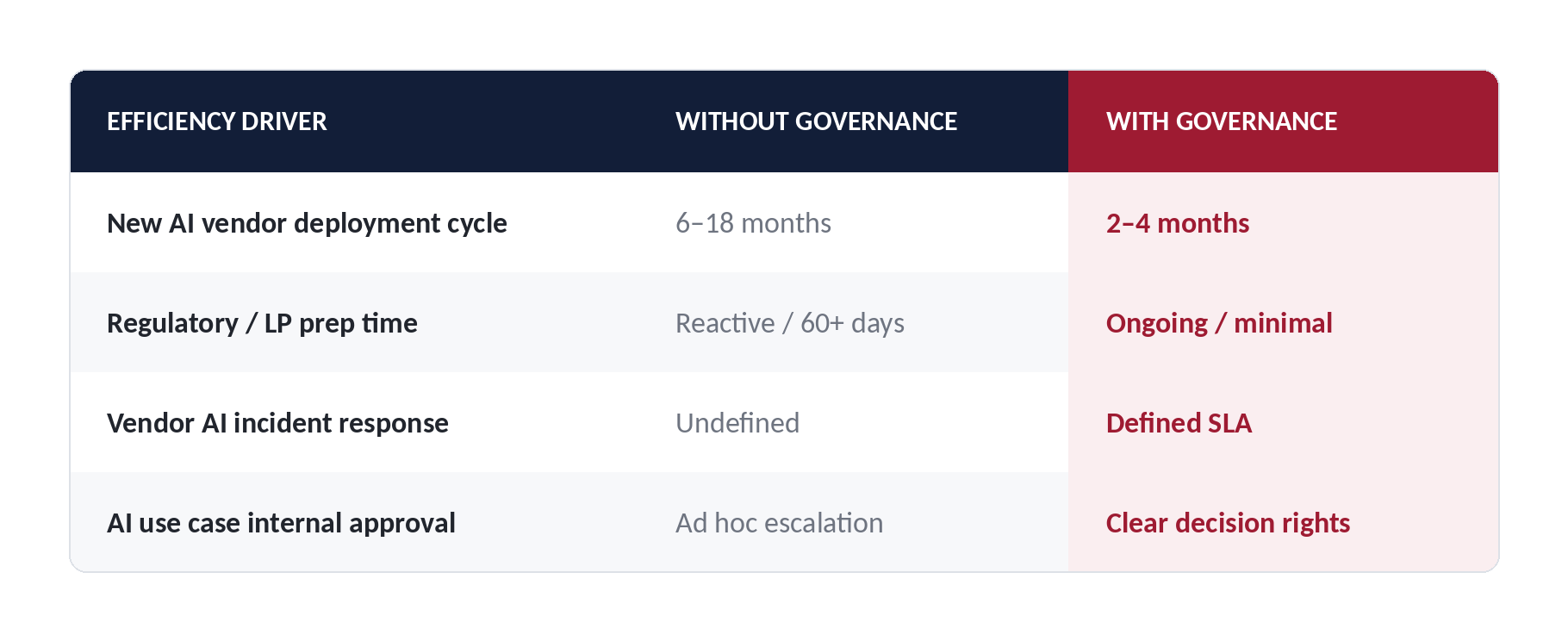
Without a governance framework, AI deployment cycles are slow and unpredictable. Legal reviews restart. IT security assessments duplicate vendor work. Business units re-escalate approvals to leadership who weren't involved in the original decision. The typical financial services firm without a defined AI governance process spends six to eighteen months in undefined review loops before deploying a new AI tool.
A mature governance program compresses that cycle. Firms that have built clear AI evaluation frameworks consistently report cutting deployment timelines by 30 to 50 percent, not by taking more risk, but by making the process explicit and the decision rights clear.
Dimension 3: Revenue Enablement
This is the argument that gets boards and investment committees moving.
AI governance isn't just about managing existing deployments, it's the infrastructure that makes new ones possible. Firms with mature governance frameworks can say yes to AI use cases that their peers have to decline.
In banking and mortgage, that means AI-driven personalization that improves cross-sell conversion, automated underwriting workflows that expand the addressable borrower population, and AI-assisted BSA/AML monitoring that reduces false positive rates and frees up analyst headcount. If AI-driven personalization improves cross-sell conversion by 15% and current cross-sell revenue is $8 million, governance is part of what makes that $1.2 million improvement accessible.
In asset management, it means AI-powered portfolio analytics that improve alpha generation, client reporting automation that scales relationship management without proportional headcount growth, and AI-assisted compliance monitoring that lets the investment team spend more time on actual investing. In private equity, it means AI-driven deal sourcing that expands the opportunity funnel, AI-assisted due diligence that compresses timelines on competitive processes, and portfolio monitoring tools that surface value creation levers earlier than a traditional quarterly review cycle would.
AI governance isn't a cost center. It's the infrastructure that determines how much of the AI opportunity your firm can actually capture.
Building the Business Case
The most effective AI governance business cases combine all three dimensions in a single view that maps to the firm's strategic plan. That's a different conversation than the traditional risk-and-compliance pitch, and it lands differently with CFOs, investment committees, and boards who have been asked to fund governance programs before without a credible answer to the ROI question.
Generic benchmarks get you to the right order of magnitude. A credible business case requires modeling against your AI footprint, your vendor mix, your current deployment timelines, and your AI-adjacent revenue opportunities. The firms that have done that modeling are getting their governance programs funded.
Where the Gaps Are: Sector-Specific Governance and the Path Forward
The AI governance problem isn't uniform across financial services. The underlying challenge, deploying AI faster than the governance infrastructure to support it, is consistent. But where the gaps show up, and what the consequences look like, differs meaningfully depending on whether you're running a regional bank, a mortgage operation, an asset management firm, or a private equity shop. Getting the governance right requires understanding the specific terrain your firm is operating in.
Banking and Mortgage: The Fair Lending Fault Line
For banks and mortgage lenders, the most consequential AI governance gap sits at the intersection of automated underwriting and fair lending. AI-driven credit decisioning tools have expanded access and compressed cycle times in ways that genuinely benefit borrowers. They've also introduced model-level risks that most institutions haven't fully inventoried.
The core problem is that many AI underwriting models were trained on historical lending data that reflects decades of unequal credit access. A model that learns patterns from that data doesn't automatically correct for those patterns, it can amplify them. When the model is a vendor-supplied black box and the institution has no line of sight into training data or bias testing methodology, it's carrying fair lending exposure it may not know exists until an examiner or a plaintiff's attorney finds it.
The governance priority for banks and mortgage lenders is clear: AI model inventory that captures vendor-supplied tools, vendor due diligence that extends to bias testing documentation, and ongoing monitoring that tracks model outputs across demographic segments, not just overall accuracy rates. Credit unions carry a version of this same exposure, with the additional weight of the cooperative mission. When a credit union deploys an AI lending model that replicates historical exclusion patterns, it isn't just taking regulatory risk. It's betraying the reason members joined.
Asset Management: The Fiduciary Accountability Gap
Asset managers are deploying AI across the investment lifecycle at a pace that's outrunning governance frameworks designed for a world of human portfolio managers making documented decisions. The specific gap depends on where AI is being used.
For quantitative and systematic strategies, the risk is model opacity, investment decisions driven by models that portfolio managers can't explain to clients or regulators when performance deviates from expectation. For discretionary managers using AI-powered research and analytics tools, the risk is undocumented model reliance, situations where a portfolio manager's investment thesis was materially shaped by an AI system that isn't reflected in the investment process documentation. For client-facing AI, reporting automation, personalized communications, AI-assisted financial planning, the risk is accuracy and attribution: AI-generated content that isn't reviewed for accuracy before reaching clients, or outputs that create implied fiduciary commitments the firm didn't intend to make.
The governance priority for asset managers is model transparency and investment process documentation. If AI is influencing investment decisions, that influence needs to be documented, disclosed, and defensible, to clients, to regulators, and to the investment committee.
Private Equity: The Due Diligence Blind Spot
Private equity firms are relative newcomers to the AI governance conversation, but they're catching up quickly, partly because deal-level AI use is accelerating, and partly because LP expectations around AI governance are hardening in ways that weren't true 18 months ago.
The governance gap for PE firms runs in two directions. The first is internal: AI tools used for deal sourcing, target screening, and portfolio company benchmarking that carry no formal governance documentation. If an investment thesis was informed by an AI system, and that system has never been validated, the intellectual basis for the investment decision becomes difficult to defend in an LP review or a legal dispute.
The second direction is due diligence: the AI governance practices of acquisition targets and portfolio companies have become a material risk factor that many PE firms aren't yet systematically assessing. A portfolio company running AI across customer-facing operations, pricing, or compliance-sensitive workflows without documented governance is carrying risk that the acquiring firm inherits at close. By the time that risk surfaces, in an examination finding, a customer complaint, or a regulatory action, the PE firm owns it.
AI governance isn't a cost center. It's the infrastructure that determines how much of the AI opportunity your firm can actually capture.
The Common Thread
Across all four sectors, the pattern is the same: AI deployment is running ahead of the governance infrastructure built to support it, and the firms that close that gap proactively are materially better positioned than those that wait for an incident to force the conversation.
The specific program looks different for a $3 billion community bank than it does for a $50 billion asset manager or a middle-market PE fund. But the underlying work, knowing what AI you have, understanding who owns the risk, building the monitoring and documentation to defend your decisions, is the same across all of them.
What Separates the Firms Winning With AI
It's not the tools. The tools are largely the same, the same vendor platforms, the same model families, often the same underlying infrastructure. It's not budget alone, though that matters at the margins. And it's not executive enthusiasm for AI, which is nearly universal across banking, asset management, and private equity at this point.
What separates them is governance infrastructure. The firms making real progress on AI have built the organizational foundation, the model inventory, the accountability structure, the vendor due diligence process, the board or LP reporting cadence, that lets them say yes to AI opportunities with confidence. The ones struggling are reacting. Approvals get stuck. Vendors get deployed without review and then pulled. Pilots stall because nobody can answer a regulator's or a client's question about how the model works. Investment decisions get challenged because the role AI played in them was never documented.
This series has made the case in three parts: the regulatory environment has opened a window rather than closed one, and governance is what lets a firm move through it (Part 1); the risk exposure is real and largely invisible inside standard vendor and compliance programs, but so is the return on closing that gap (Part 2); and where that gap actually lives depends on the sector, from fair lending in banking to fiduciary documentation in asset management to due diligence in private equity (Part 3).
The Firms That Move Now
The financial services firms that invest in AI governance infrastructure over the next 12 to 18 months will have built something durable, not a compliance program they have to maintain, but a capability that compounds. Each AI deployment gets easier because the process exists. Each vendor negotiation goes better because they know what questions to ask. Each examination, investor meeting, or due diligence conversation gets cleaner because the documentation is already built.
More importantly, they'll have defined what good AI governance looks like in their market. Their peers will spend years trying to catch up to a standard they helped establish.
The firms that wait will get there eventually. But they'll arrive under more pressure, with less runway, and almost certainly with at least one incident, a finding, a client complaint, a deal-level liability event, that made the conversation unavoidable.
The governance window is open. The firms that move through it now will define the standard. The ones that wait will be measured against it.
Want help building the AI governance ROI case for your firm?
We help banks, asset managers, and private equity firms structure the business case for AI governance in terms that resonate with CFOs, investment committees, and boards. Let's talk.