

The Real Cost of Waiting:
Vendor AI Risk and the Business Case for Governance
Part 2 of a 3-Part AI Governance Thought Leadership Series
By Norwin Estrada - Risk Management Practice Leader
The Real Cost of Waiting: Vendor AI Risk and the Business Case for Governance
The Upside Nobody Talks About
Here's what gets overlooked: getting serious about vendor AI risk gives your firm leverage it wouldn't otherwise have.
Firms with mature vendor AI due diligence can negotiate better contracts, extract more transparency from vendors competing for their business, and move faster on vendor AI deployments because the evaluation process already exists. In banking, that means new fraud or lending AI tools can go live in weeks rather than months. In asset management, it means AI-powered analytics platforms can be onboarded with confidence rather than anxiety. In private equity, it means due diligence on acquisition targets that use AI can be completed, and documented, in a way that holds up to LP scrutiny.
Vendor AI risk management isn't just defensive. Done well, it's a competitive advantage, the difference between firms that can move on AI opportunities quickly and firms that are perpetually stuck in a review process with no defined endpoint.
What Is AI Governance Actually Worth?
At some point in every AI governance conversation, someone with a budget asks a version of the same question: what's the return on this investment? It's a fair question. Governance programs have historically been hard to quantify, which is a big part of why they've historically been underfunded.
AI governance, done right, is actually one of the more measurable investments a financial services firm can make. The costs of not doing it are specific, observable, and increasingly well-documented. The ROI case has three components: risk avoidance, operational efficiency, and revenue enablement. Most firms only make the first argument. The full picture is considerably more compelling.
Dimension 1: Risk Avoidance Value
The downside of ungoverned AI is quantifiable in ways that traditional operational risk events often aren't. The numbers already on the books are instructive. Generative AI-related lawsuits in the U.S. grew significantly between 2021 and 2025. AI examination findings at regulated institutions are generating remediation costs ranging from hundreds of thousands to several million dollars. Cyber insurance exclusions for AI-related incidents are expanding. The risk of uninsured loss from an AI incident is rising, not falling.
But the risk avoidance calculus looks different depending on sector. For banks and mortgage lenders, the primary exposure is fair lending liability and examination findings tied to AI-assisted underwriting. A single consent order tied to an ungoverned AI model can carry direct costs well into eight figures, plus the operational drag of years of enhanced supervision. For asset managers, the exposure is fiduciary liability and client trust, the cost of an AI-driven investment decision that can't be explained to a client or a regulator. For private equity, it's increasingly deal-level: firms that can't demonstrate AI governance standards during due diligence are starting to see it reflected in valuations and investor expectations.
Dimension 2: Operational Efficiency Gains
This is the component most governance conversations skip, and it's often the largest number on the table.
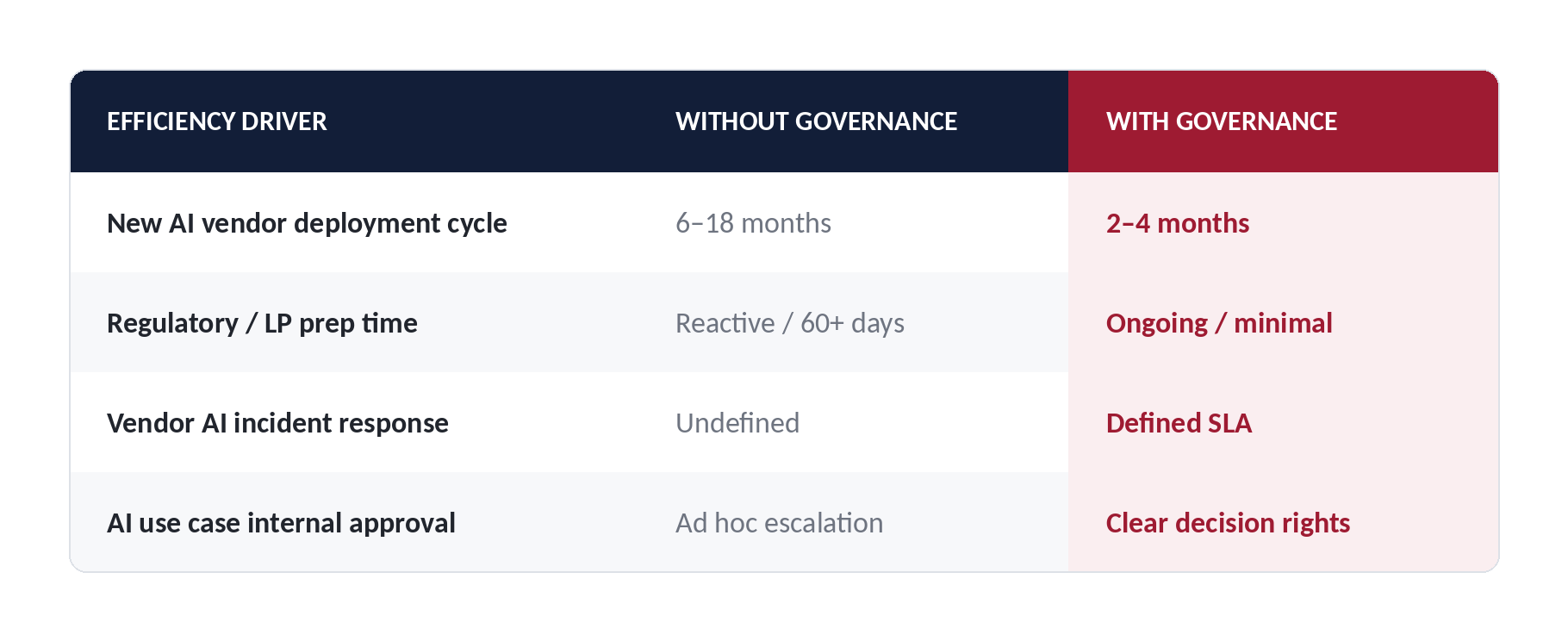
Without a governance framework, AI deployment cycles are slow and unpredictable. Legal reviews restart. IT security assessments duplicate vendor work. Business units re-escalate approvals to leadership who weren't involved in the original decision. The typical financial services firm without a defined AI governance process spends six to eighteen months in undefined review loops before deploying a new AI tool.
A mature governance program compresses that cycle. Firms that have built clear AI evaluation frameworks consistently report cutting deployment timelines by 30 to 50 percent, not by taking more risk, but by making the process explicit and the decision rights clear.
Here's a scenario that plays out constantly across financial services right now. A firm contracts with a vendor to provide a platform, fraud detection, loan origination, AML monitoring, portfolio analytics, deal sourcing. Embedded in that platform is a machine learning model making real decisions. The firm's risk team reviews the contract. They check the SOC 2. They run the standard TPRM questionnaire.
Nobody asks how the model was trained. Nobody asks what data went into it. Nobody asks what happens when the vendor pushes an update. Nobody asks who's accountable when it gets it wrong.
And then it gets it wrong, and the regulatory finding, the client complaint, or the deal-level liability lands on the firm, not the vendor.
This isn't a hypothetical. It's the pattern that regulators, plaintiffs' attorneys, and AI liability insurers are watching closely right now, across banking, asset management, and private equity alike.
The Vendor AI Blind Spot
Third-party vendors are the dominant AI delivery channel across financial services. Most institutions and firms have never formally inventoried these tools as models, let alone validated or monitored them.
The use cases vary by sector, but the governance gap is the same. Banks and mortgage lenders rely on vendor AI for underwriting decisions, fraud alerts, and AML triage, tools that directly influence regulatory outcomes and fair lending exposure. Asset managers use vendor AI for portfolio risk analytics, trade execution optimization, and client reporting, systems that affect fiduciary obligations and performance attribution. Private equity firms are increasingly using AI-powered platforms for deal sourcing, target screening, and portfolio company benchmarking, tools that shape investment theses and, increasingly, LP expectations around due diligence rigor.
SR 26-2 is clear on accountability: outsourcing a model does not transfer the regulatory responsibility. What it transfers is visibility, which is exactly the problem. Most firms have no line of sight into how their vendor AI was built, what data it was trained on, or whether it's been tested for the specific exposures relevant to their business.
What Standard TPRM Misses
Most third-party risk management programs were built for a pre-AI world. They assess operational resilience. They review data security posture. They check business continuity plans. All important, and none of it addresses the model governance practices inside a vendor's AI product.
They don't ask whether a vendor's credit model has been tested for disparate impact. They don't ask whether a portfolio analytics model has been validated on data that matches the firm's actual investment universe. They don't ask whether a deal-sourcing AI has been stress-tested for market regime changes or whether its outputs carry any audit trail. They don't ask who to call when the model starts behaving differently after a silent update.
Those aren't exotic questions. They're what separate firms with defensible AI risk postures from those that have effectively outsourced their risk management to a vendor capping liability at 12 months of fees.
The vendor agreement protects the vendor. Your governance program is what protects your firm.
Dimension 3: Revenue Enablement
This is the argument that gets boards and investment committees moving.
AI governance isn't just about managing existing deployments, it's the infrastructure that makes new ones possible. Firms with mature governance frameworks can say yes to AI use cases that their peers have to decline.
In banking and mortgage, that means AI-driven personalization that improves cross-sell conversion, automated underwriting workflows that expand the addressable borrower population, and AI-assisted BSA/AML monitoring that reduces false positive rates and frees up analyst headcount. If AI-driven personalization improves cross-sell conversion by 15% and current cross-sell revenue is $8 million, governance is part of what makes that $1.2 million improvement accessible.
In asset management, it means AI-powered portfolio analytics that improve alpha generation, client reporting automation that scales relationship management without proportional headcount growth, and AI-assisted compliance monitoring that lets the investment team spend more time on actual investing. In private equity, it means AI-driven deal sourcing that expands the opportunity funnel, AI-assisted due diligence that compresses timelines on competitive processes, and portfolio monitoring tools that surface value creation levers earlier than a traditional quarterly review cycle would.
AI governance isn't a cost center. It's the infrastructure that determines how much of the AI opportunity your firm can actually capture.
Building the Business Case
The most effective AI governance business cases combine all three dimensions in a single view that maps to the firm's strategic plan. That's a different conversation than the traditional risk-and-compliance pitch, and it lands differently with CFOs, investment committees, and boards who have been asked to fund governance programs before without a credible answer to the ROI question.
Generic benchmarks get you to the right order of magnitude. A credible business case requires modeling against your AI footprint, your vendor mix, your current deployment timelines, and your AI-adjacent revenue opportunities. The firms that have done that modeling are getting their governance programs funded.
Want help building the AI governance ROI case for your firm?
Clarendon Partners can help banks, asset managers, and private equity firms structure the business case for AI governance in terms that resonate with CFOs, investment committees, and boards. Let's talk.